
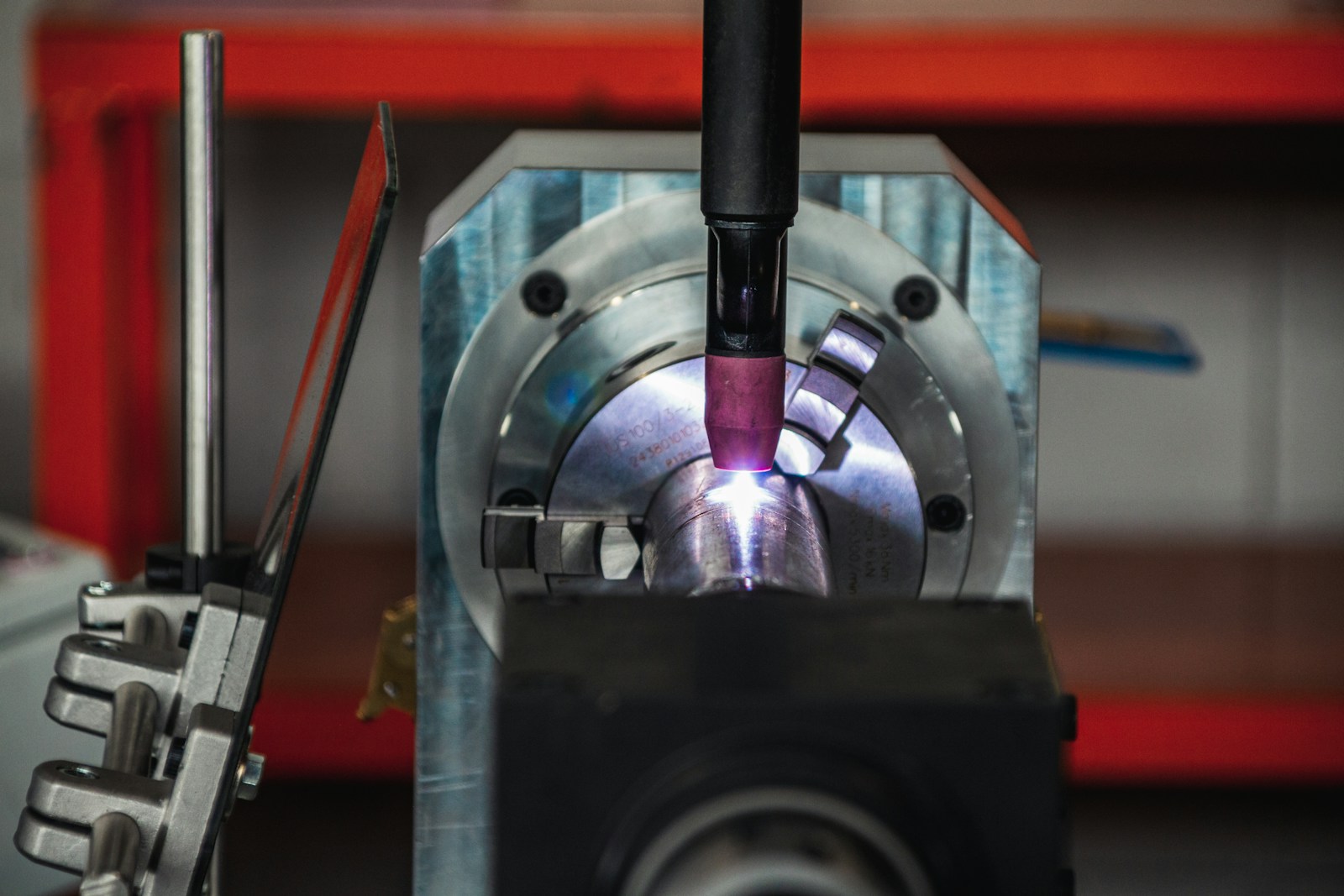
Principle of orbital welding
An orbital weld is made by a tungsten electrode orbiting around the circumference of a clamped pipe, driven by a mechanized weld head. The operator doesn't weld with their hands — they program the machine. The head carries the torch, wire feeder and gas nozzles and travels 360°+ (with 15–30° overlap to bridge the start and end points).
A short history
Orbital welding was born in the early 1960s when NASA needed to weld the hydraulic lines of the Saturn V rocket with a repeatability no manual welder could guarantee. The first commercial orbital heads (Astro Arc, Magnatech) entered industry in the 1970s. In Europe they spread massively with the arrival of the semiconductor industry (Intel Ireland, Infineon) in the 1980s — because chip fabs needed ultra-clean gas and process lines without contamination.
Main players on the market
▸ AXXAIR (France) — compact SX/SXE heads, specializing in sanitary and pharmaceutical lines. ▸ Orbitalum (Germany, Bosch group) — robust OW heads plus famous GFX pipe cutters. ▸ Orbitec (USA) — high-end heads for the nuclear and semiconductor industries. ▸ Magnatech (USA), AMI (USA) — for large diameters and special applications.
Why orbital wins where manual TIG can't keep up
Repeatability — orbital lays 200 welds per shift with identical quality hour after hour, while a manual TIG welder's productivity fluctuates depending on how good their breakfast was. In GMP sanitary work (3-A standards, EHEDG) manual welds are simply not accepted — everything must be automated. In nuclear power plants (ASME III) every single weld has a documented program with revision control.
Did you know?
▸ An orbital head typically rotates at 80–200 mm/min but pulses current 100× faster — three times faster than a human welder can react. ▸ The smallest orbital head, AXXAIR SX 8, welds tubes from Ø 3.2 mm (laboratory applications). ▸ The largest orbital systems weld oil pipelines DN1200+ (1.2 m diameter) in a single pass. ▸ Head + power source cost: €8,000 – €60,000 depending on size and channel count.